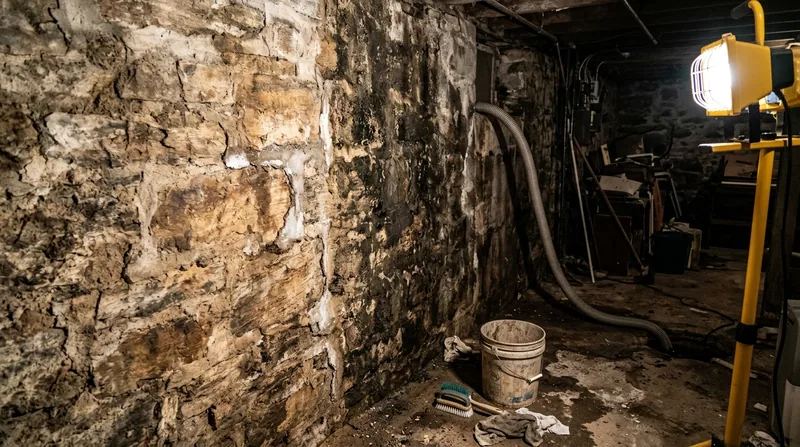




Fayetteville sits on chert-rich clay residuum over cracked limestone, and that karst layer sends storm water straight into foundation joints and block cores. When it seeps into a small full basement under a 1920s bungalow near the historic square, or a partial cellar under the front rooms of a University of Arkansas rental, the wet drywall and framing become a moisture problem within days. Basement Mold Remediation in Fayetteville means two jobs done together: remove the mold growth on the affected materials and fix the water path that fed it. We handle both, because treating the fungus without stopping the seepage just buys time. Call (479) 318-0517 for a free basement inspection and a straight read on what is actually wet.
Why Basement Mold Keeps Coming Back in Fayetteville Homes
Most basements in this metro are small and old, tucked under the front rooms of 1900s to 1930s brick and frame houses near the square and the university. Those walls are usually unsealed brick or block, and the clay residuum outside holds water against the foundation for days after a spring storm. The mold does not need a flood. It needs damp masonry and still air.
- Hydrostatic pressure pushes water through mortar joints and hairline cracks after heavy spring rain.
- Efflorescence on the wall face tells you water is moving through the masonry, not just condensing on it.
- A musty basement smell usually means mold growth behind paneling, under stair framing, or in carpet tack strips.
- Downspouts that dump at the corner and grading that slopes back to the wall feed the same wall year after year.
Find the moisture source first, then treat the growth, or the same wall blooms again by July.
Key info: A 1928 Foursquare off Garland Avenue had mold on the lower two courses of block and the back of the stair stringer. The wall read damp all summer. The cause was a downspout discharging two feet from the corner and grading that had settled toward the foundation. Sealing alone would not have held.
For official guidance on moisture and mold in buildings, the U.S. EPA maintains a plain-language resource at https://www.epa.gov/mold.
How We Run a Basement Mold Job in Fayetteville
We work wet side first. That means finding where the water enters (wall crack, cove joint, window well, or a failed sump basin in one of the few lower levels) and correcting it before any surface treatment. Then we contain, remove, and treat. Every job gets a musty smell diagnostic so we are not guessing at hidden growth.
- We inspect the basement walls, floor cove, window wells, and sump area, and map moisture with a pin meter.
- We identify the water path: crack injection, cove seepage, failed drain tile, or grading and downspout discharge.
- We set containment and negative air so spores do not spread to the living space above.
- We remove porous materials that cannot be cleaned, then treat the remaining surfaces with an antimicrobial.
- We correct the moisture source, which may mean epoxy or polyurethane injection, an interior perimeter drain, or a sump and discharge line.
- We verify dry conditions and leave a written summary of what was treated and what was corrected.
If the source is a failed sump, we quote the pump and the discharge correction on the same visit so the mold work is not undone by the next storm.
Key info: A 1990s walkout in Johnson had mold on the lower drywall of the downhill wall and a musty smell in the finished room. The sump pump had failed silently and the check valve was stuck. We replaced the pump, corrected the discharge line, removed the affected drywall, and treated the framing. The room stayed dry through the next spring.
Remediation Approaches We Use
The right approach depends on what is growing, what it is growing on, and how the water is getting in. We match the method to the material and the moisture source, not to a package.
| Approach | Description | Best for |
|---|---|---|
| Surface treatment and cleaning | HEPA vacuuming, wire brushing, and antimicrobial treatment of block and concrete walls. | Light growth on masonry that is structurally sound. |
| Containment and removal | Negative air, poly containment, and removal of moldy drywall, insulation, or carpet. | Growth on porous materials or a musty smell in finished rooms. |
| Crack injection and wall sealing | Epoxy or polyurethane injection of active cracks, plus basement wall sealing where seepage is diffuse. | Water entering through cracks or porous block faces. |
| Interior perimeter drain and sump | Interior drain tile at the cove joint feeding a sump basin and pump with a check valve. | Hydrostatic pressure at the floor joint or repeated seepage after storms. |
| Dehumidification and ventilation | Sized dehumidifier and air movement to keep basement humidity in check. | Damp, still basements where condensation feeds growth. |
We tell you plainly when a crack repair is enough and when the real problem is hydrostatic pressure that needs drainage. That honesty is the point of hiring a specialist.
Basement Mold Remediation Cost in Fayetteville: What to Expect
Most basement mold jobs here start from $1,500, and that figure usually covers a modest area of growth on masonry plus treatment and the moisture correction that goes with it. The number moves with the square footage affected, whether drywall or framing has to come out, and whether the fix is a crack injection or a full interior drain system. A single wall crack with light growth sits at the low end. A finished walkout with moldy drywall, a failed sump, and a wet floor cove can run several thousand, because the water correction is the larger part of the job.
Get two or three estimates and compare what each one includes for the moisture source, not just the surface cleaning. A quote that treats mold without naming the water path is incomplete. Our full pricing overview is at https://fayetteville-ar-waterproofing.com/pricing/.
Hiring a Basement Mold Contractor Near Me in Fayetteville
Ask three things before you sign: are you licensed and insured, what is the moisture source you found, and what happens if the wall stays damp after treatment. A contractor who cannot answer the second question is selling cleaning, not remediation. Check references from jobs in Fayetteville or Springdale, and confirm the scope in writing.
- Confirm licensing and insurance, and ask for a certificate before work starts.
- Get two or three written estimates that separate remediation from the water correction.
- Ask whether permits are needed for any structural or drainage work, and check with the local building department because thresholds vary.
- Ask how they verify dryness after treatment, and whether they include a follow-up visit.
Start with a free inspection and a straight conversation. Reach us at https://fayetteville-ar-waterproofing.com/contact/ or call (479) 318-0517.
Basement Mold Remediation in Fayetteville: Pricing Guide
| Service | Price | Details |
|---|---|---|
| Surface mold treatment on masonry | Starting at $1,500 | Covers HEPA cleaning, antimicrobial treatment, and a moisture source check on a small basement wall area |
| Containment and removal of moldy materials | Starting at $2,400 | Includes negative air, poly containment, and removal of affected drywall or insulation in a finished area |
| Remediation with crack injection or sealing | Starting at $2,900 | Adds epoxy or polyurethane injection and wall sealing where seepage through cracks fed the growth |
| Remediation with interior drain and sump | On estimate | Full perimeter drain and sump correction priced after an on-site look at the hydrostatic pressure and discharge route |
| Travel | Included | In Fayetteville and surrounding areas, no separate call-out or mileage fee |
| Estimate | Free | Response within 24h at (479) 318-0517, no obligation to book |
Indicative pricing, the exact cost depends on square footage, finish, and site access. Free personalized estimate within 24h at (479) 318-0517.


