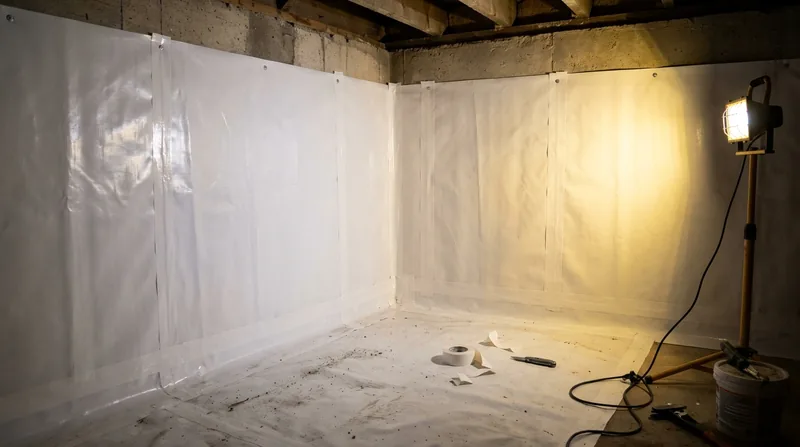




Fayetteville's ground is chert-rich clay residuum sitting over cracked limestone, a karst layer that lets water move fast after the heavy spring storms. In the 1900s-1930s brick bungalows and Foursquares near the historic square and the University of Arkansas, that moisture pushes through the porous brick and up through the slab as vapor, not always as a visible puddle. Vapor Barrier Installation in Fayetteville is how we stop that ground vapor before it reaches the living space, sealing the walls and slab edge with heavy-duty sheet and taped terminations. We handle the below-grade side only, and we tell you plainly when a barrier is the right fix and when the real problem is hydrostatic pressure that needs drainage first. For the broader picture of how moisture moves through your foundation, see our basement waterproofing page.
Why Vapor Barrier Installation Matters in Fayetteville's Clay and Karst Ground
Most of the metro sits on slab-on-grade or raised floors, so the basements we do see are the small full cellars and partial rooms under the front of the older homes. Those spaces sit directly against clay that holds winter rain and spring runoff, and the vapor wicks in slowly, showing up as efflorescence, a musty smell, and damp drywall long before a puddle forms. A barrier changes that path.
- It blocks ground moisture vapor from crossing the wall and slab surface, which is the source of most musty basement smell complaints we get.
- It stops the efflorescence cycle that eats at brick and block faces over the years.
- It gives the interior drain tile and sump system a dry surface to work against instead of fighting constant humidity.
- It keeps stored items, framing, and finishes out of direct contact with damp masonry.
When a Fayetteville homeowner calls about a wet basement, the barrier is often one piece of the answer, and the drainage is the other.
Key info: On a 1920s Foursquare off Garland Avenue, the cellar wall read damp and chalky every March but never showed a running leak. The fix was a sealed wall barrier tied into the existing sump basin, not excavation. Two blocks away, a 1990s walkout in Johnson needed drain tile first because the water was actually pooling.
For the local code side, check the City of Fayetteville building permit portal at fayetteville-ar.gov before any work that alters drainage or ties into a sump discharge, since thresholds vary and the building department has the final word.
How We Install Vapor Barriers in Fayetteville Homes
We start by finding where the moisture is actually coming from, because a barrier over an active leak traps water and makes the problem worse. On the older brick homes near the square, that means checking the mortar joints and the slab edge for wicking; on the newer slab-on-grade subdivisions in Springdale and Farmington, it means confirming the slab is dry enough to receive the sheet. Then we install to the wall and slab as one sealed system.
- We inspect the walls, slab, and sump pit and note any active seepage or crack that needs foundation crack repair before the barrier goes up.
- We clean and prep the masonry so the adhesive and termination tape bond to a sound surface, not to efflorescence or loose parging.
- We cut and fit heavy-duty barrier sheet to the wall height and slab dimensions, keeping a continuous run where possible.
- We seal every seam and termination with compatible tape and mastic, and we lap the sheet into the sump basin where one exists.
- We integrate the barrier with the sump pump and check valve so discharge water never runs back against the new sheet.
- We walk the job with you and explain what to watch for in the first wet season.
Every install ends with a moisture check at the base of the wall, because that is where a bad seam shows up first.
Key info: In a 1950s brick ranch on the south side of Fayetteville, the slab edge was the only wet spot after every heavy rain. We ran the barrier down the wall and across the slab edge, tied it to a new sump basin, and the musty smell cleared within a month. No excavation was needed.
If your lower level already has standing water or a failed pump, start with sump pump installation and replacement so the barrier is not fighting an active flow.
Vapor Barrier Approaches We Use in the Fayetteville Metro
Not every lower level takes the same sheet or the same termination detail. The right approach depends on whether you have a true cellar, a partial room under the front of an older home, or a slab edge that wicks into a finished space. Here is how the options compare in our local building stock.
| Approach | Description | Best for |
|---|---|---|
| Wall and slab sheet barrier | Heavy-duty sheet run continuously from wall to slab edge, all seams taped and terminated. | Full cellars in older brick homes near the historic square. |
| Dimple board drainage mat | Dimpled membrane that holds the barrier off the wall and lets moisture drain down to the footing. | Walls with active seepage where drainage must stay open behind the sheet. |
| Sump-integrated barrier | Barrier lapped and sealed into the sump basin, with the check valve and discharge line checked at the same time. | Lower levels that already have a sump pit and pump. |
| Slab-edge vapor seal | Targeted seal at the slab perimeter where vapor wicks into a finished floor. | Raised-floor and slab-on-grade homes in Springdale and Farmington. |
| Barrier over new parging | Fresh parging on the masonry first, then the sheet, for a smooth bonded surface. | Crumbling or chalky walls that will not hold tape otherwise. |
The right row on that table is decided on site, not over the phone, because the wall tells us which one it needs.
Vapor Barrier Installation Cost in Fayetteville: What to Expect
We start most barrier work at From $3/sq ft, which covers the sheet, the seam tape and mastic, and the labor to fit and seal it to the wall and slab. That figure moves with wall height, how much prep the masonry needs, whether the sheet has to lap into a sump basin, and how many terminations and penetrations we have to detail. A clean 1930s cellar wall is a different job from a chalky wall that needs parging first.
Getting two or three estimates is smart in this market, but compare scope, not just the number. Ask each contractor whether the price includes seam tape, sump integration, and disposal, because a low bid that skips the terminations is not the same job. Our full breakdown lives on the pricing page.
One more cost factor specific to Fayetteville: if the barrier has to go over a wall that is bowing, the wall needs attention first, and that changes the budget entirely.
What to Look For When Hiring a Vapor Barrier Contractor Near Fayetteville
Ask for the license and insurance certificate before anyone walks your basement, and confirm the coverage is current, not just that the company says it is. Ask how many barrier jobs the crew has done on brick cellars versus slab-on-grade, because the two demand different prep. Ask for references from Fayetteville or Springdale homeowners you can actually call, and ask whether the quote includes permits where the local building department requires them.
If your home sits in an HOA in a newer subdivision, confirm the association's rules on exterior discharge and grading before work starts. And be wary of any contractor who promises a lifetime warranty or tells you a barrier alone will fix an active leak, because neither is honest. We offer a transferable warranty and we tell you when drainage comes first.
When you are ready, reach out through our contact page and we will schedule a free inspection.
Vapor Barrier Installation in Fayetteville: Pricing Guide
| Service | Price | Details |
|---|---|---|
| Wall and slab sheet barrier | Starting at $3/sq ft | Includes heavy-duty sheet, seam tape, mastic, and full wall-to-slab termination labor. |
| Dimple board drainage mat | Starting at $4/sq ft | Adds dimpled membrane behind the sheet; price rises with wall height and prep. |
| Sump-integrated barrier | Starting at $4.50/sq ft | Includes lapping and sealing into the sump basin plus check valve inspection. |
| Slab-edge vapor seal | Starting at $2.50/sq ft | Targeted perimeter seal for slab-on-grade and raised-floor homes; smaller scope, lower rate. |
| Complex or large-scale job | On estimate | Bowing walls, heavy parging repair, or multiple rooms need an on-site look before pricing. |
| Travel | Included | In Fayetteville and surrounding areas, no separate call-out or mileage fee. |
| Estimate | Free | Response within 24h at (479) 318-0517, no obligation to book. |
Indicative pricing, the exact cost depends on square footage, finish, and site access. Free personalized estimate within 24h at (479) 318-0517.


