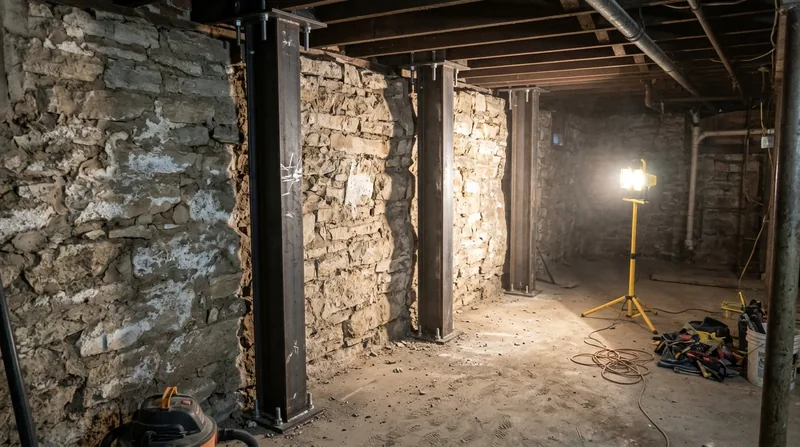




Bowing Wall Repair in Fayetteville: When Wet Clay Pushes Back
When a foundation wall leans or bulges inward, the cause is almost always hydrostatic pressure from saturated clay pushing against the wall. In Fayetteville, that pressure builds fast: chert-rich clay residuum over cracked limestone holds water after heavy spring storms, and the water table can rise against older block and stone walls near the historic square and the University of Arkansas. We handle Bowing Wall Repair in Fayetteville with carbon fiber straps, steel I-beams, and wall anchors matched to how far the wall has moved and how much wet clay sits behind it. If you have spotted a crack or a lean, start with a foundation crack repair assessment before the movement gets worse.
Why Bowing Walls Show Up in Fayetteville's Older Brick and Block Foundations
Most of the bowing walls we see are in 1900s-1930s brick bungalows and Foursquares with small full basements or partial cellars under the front rooms. Those walls were built with lime mortar and unreinforced block, and they have spent a century absorbing seasonal movement from expansive clay. The karst layer underneath sends water into footing joints, so a wet winter can push a wall inward by fractions of an inch that add up over years.
- You see horizontal cracks in the middle third of a block wall, which signals pressure rather than settlement.
- You notice the top of the wall leaning in while the base stays put, a classic sign of clay loading at mid-height.
- You find efflorescence or white mineral bloom along the wall, proof that water is moving through the masonry.
- You spot doors or windows that stick more in spring than in fall, as the wall flexes with moisture.
Any one of these is worth a look before the next wet season adds more load.
Key info: A 1920s brick Foursquare near the Fayetteville square had a rear basement wall bowing about 1.5 inches after a wet March. The homeowner had sealed the cracks twice with hydraulic cement, but the wall kept moving because the water behind it had nowhere to go.
For official guidance on structural permits, check the City of Fayetteville building department before any wall stabilization work begins.
How We Stabilize a Bowing Wall in Fayetteville
We start by measuring the movement, not guessing at it. A plumb line and a level tell us how far the wall has traveled, and a moisture reading tells us whether the clay behind it is still active. From there we match the repair to the severity: carbon fiber straps for walls that have moved less than 2 inches, steel I-beams for heavier loads, and wall anchors when the pressure needs to be relieved from the outside.
- We inspect the wall, the footing, and the drainage on the exterior to find where the water is coming from.
- We measure the bow with a plumb line and record crack widths at the top, middle, and bottom.
- We recommend carbon fiber straps, steel I-beams, or wall anchors based on the movement and the clay pressure.
- We install the system and torque it to spec, then re-check the wall against the baseline.
- We correct the water source with grading, downspout extensions, or an interior perimeter drain so the pressure does not return.
The structural repair stops the movement, but the drainage correction is what keeps it stopped.
Key info: In a 1990s walkout subdivision in Johnson, a block wall on the uphill side had bowed about an inch. Carbon fiber straps stabilized it, and a interior drain tile system relieved the water that was feeding the clay.
Bowing Wall Repair Methods We Use in Fayetteville
Each method solves a different problem, and the right one depends on how much the wall has moved and how much room you have to work. We choose the least invasive option that will hold the wall, not the most expensive one.
| Approach | Description | Best for |
|---|---|---|
| Carbon fiber straps | Epoxy-bonded straps span the crack and resist tension | Walls with less than 2 inches of movement |
| Steel I-beams | Vertical beams anchored to floor and joist | Heavier block walls with active pressure |
| Wall anchors | Earth anchors pull the wall back from outside | Walls that need to be straightened, not just held |
| Epoxy injection | Ports inject epoxy into cracks to restore strength | Non-moving cracks that need sealing |
| Drainage correction | Grading, downspout extensions, interior drain | Every bowing wall, to remove the cause |
We pair every structural repair with a drainage fix, because a strap on a wet wall is a temporary answer.
Bowing Wall Repair Cost in Fayetteville: What to Expect
Most bowing wall repairs in Fayetteville start around $600 for a small crack injection or a single carbon fiber strap on a minor bow. A full wall stabilization with steel I-beams or anchors runs higher because it involves more material, more labor, and often an exterior excavation. The number depends on how far the wall has moved, how long the wall is, and whether we have to dig outside to relieve pressure.
We give you 2-3 estimates because the range is wide. A wall that has moved half an inch and a wall that has moved two inches are different jobs, and the price should reflect that. For a full breakdown of what we charge, see our pricing page.
What to Look for When Hiring a Bowing Wall Repair Contractor Near Fayetteville
Bowing wall repair is structural work, so the contractor you hire should be licensed and insured, and should be able to show you a certificate of insurance without being asked. Get 2-3 estimates and compare the method, not just the price. Ask for references from jobs in Fayetteville or Springdale and call them. Permits for structural foundation repair vary by jurisdiction, so confirm with the city before work starts. If you are in a subdivision with an HOA, check the rules on exterior excavation and drainage changes before you sign.
Reach out through our contact page to schedule an inspection.
Bowing Wall Repair in Fayetteville: Pricing Guide
| Service | Price | Details |
|---|---|---|
| Crack injection (epoxy or polyurethane) | Starting at $600 | Includes port installation and injection of one crack up to 8 feet; longer or multiple cracks raise the price |
| Carbon fiber strap installation | Starting at $900 | Includes one strap and surface prep; wall length and number of straps move the price |
| Steel I-beam stabilization | Starting at $2,500 | Includes beam, anchoring, and torque to spec; wall height and access drive the cost |
| Wall anchor system | On estimate | Requires exterior excavation and soil assessment, so we price it after an on-site look |
| Travel | Included | In Fayetteville and surrounding areas, no separate call-out or mileage fee |
| Estimate | Free | Response within 24h at (479) 318-0517, no obligation to book |
Indicative pricing, the exact cost depends on square footage, finish, and site access. Free personalized estimate within 24h at (479) 318-0517.


